


MIOSOTIS HEALTHY LIFE PLANS
Two alternatives are provided.
(Standard, and Premium plans).
The participant can select the one that best suits their preferences.
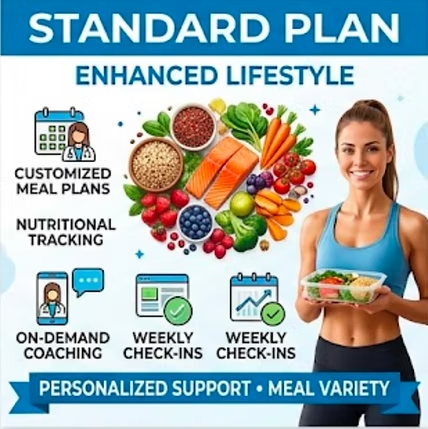
STANDARD PLAN
- Select the Standard Plan if you think you need some support to fulfill the weight loss and healthy eating programme.
- In each phase of the programme, we will help you achieve your weight and healthy eating goals.
- It is a more customized program, with weekly assessment of biometric parameters.
The Standard Plan includes:
1. ) Miosotis Healthy Life Program – Printed Edition
– Duration: 24 weeks, divided into 6 phases.
–Format: A high-quality book that may be purchased online or in physical bookshops.
–Purpose: to facilitate in-person consultation and the manual recording of notes, weight, waist circumference and vital signs, allowing the participant to track their progress in a tangible way.
– Monitoring: The data must be recorded weekly in the online section so that the clinical team can assess progress and adjust the menu for the next phase.
2.) Standard menu for each phase
– Structure: Base menu provided in 1500, 1800 and 2000 kcal formats for each phase.
– Adaptation: Users should adjust the menu in line with their biometric progress, dietary restrictions and the clinical team’s recommendations.
– Online support: Weekly access to the standard recommendations and to the adjustments suggested by the clinical team at the end of each phase to improve the eating plan.
3.) Healthy Eating Literacy Programme
– Purpose: Understanding and applying nutritional information to make informed, balanced dietary decisions. It is not merely a matter of having theoretical knowledge, but of turning that knowledge into practical everyday action.
– Knowing how to choose: Understanding and interpreting the nutritional labels and traffic-light labelling on supermarket products.
– Knowing how to plan: Managing the budget, selecting foods and structuring varied meals.
– Knowing how to prepare: Preparing food safely and healthily.
– Critical thinking: Distinguishing recommendations based on scientific evidence from nutritional misinformation.
– Disease prevention: It acts as a public health tool to prevent obesity, diabetes and cardiovascular problems.
4.) Monitoring of weight and waist circumference at each phase
–Key indicators: Weight and waist circumference are the fundamental metrics for measuring the effectiveness of the programme and the reduction in cardiovascular risk.
– Dynamic adjustment: Monitoring takes place at the end of each phase so as to allow the precise adjustment of the menus (standard and personalised) for the next phase.
5. ) Weekly standard menu
– Structure: Standard menu provided at the start of each week, in 1500, 1800 and 2000 kcal formats per day.
– Adaptation: Users should adjust the menu in line with their biometric progress, dietary restrictions and the clinical team’s recommendations.
– Online support: Weekly access to the standard recommendations and to the adjustments suggested by the clinical team at the end of each phase in order to improve the eating plan for the following phase.
6. ) Physical activity advice
– Frequency: A minimum recommendation of 30 minutes a day.
– Method: The focus is on integrating physical exercise into the daily routine (making use of everyday routines to be physically active, and exercises at home such as press-ups, sit-ups and squats), rather than being limited to running or walking.
– Benefits: Reduced cardiovascular risk, weight loss, improved sleep, reduced stress and the prevention of chronic diseases.
– Flexibility: Teaching “physical activity equivalents” so that exercise can be adapted to everyone’s lifestyle .
7. ) Motivational advice
– Mindful Eating: Turning the act of eating into a mindful ritual, eliminating the automatic consumption of food and excessive alcohol intake.
– Emotional Control: Learning to distinguish physical hunger from emotional hunger (“cravings”) in order to eliminate compulsive behaviours.
– Techniques: Eating slowly, recognising the signs of satiety, using the five senses and dealing with guilt or food-related anxiety.